Threat intelligence with confidence you can audit.
OpenInvestigation pulls public evidence on IOCs, actors, malware and campaigns from 25+ graded sources, grades every claim on the Admiralty scale, and derives a 0–5 confidence in code — capped by how many independent origins agree. The model writes the assessment; it never sets the score.
$ git clone https://github.com/V1n1v131r4/OpenInvestigation.git
$ cd OpenInvestigation
$ docker compose up --build -d
# open http://127.0.0.1:8080
Sources
25+ sources, and you control what leaves the box
Every source is classed by what it does to your indicator. The per-case TLP decides which classes run, and a query log records exactly what each one received.
On your machine
No request leaves the host. Your own corpus and prior work.
Downloaded, matched offline
Feeds are fetched whole, then matched locally — the seed is never sent to a third party.
Send the indicator out
These query a third party with your seed, so each is opt-in per case and written to the query log.
Each collector has typed errors and response-size limits, and all collected text is treated as untrusted. Add provider keys to a local .env to light up the authenticated sources — all optional.
Grading & confidence
Every claim carries a grade. The score is math, not vibes.
OpenInvestigation speaks the Admiralty System, then turns those grades into a 0–5 confidence with a pure, reviewable function — capped by independence so a single well-cited source can't masquerade as consensus.
Reliability — the source
A (completely reliable) → F (cannot be judged). The shipped table is deliberately conservative: unknown sources default to F.
Credibility — this claim
1 (confirmed) → 6 (cannot be judged), derived in code from each item's qualifier.
The 0–5 score is computed by a pure function and ships with its reasons. Independent clusters — not raw hit count — set the ceiling.
- 5Confirmed consensus. Two or more independent clusters with confirmed (credibility 1) evidence.
- 4Corroborated. Two or more independent clusters with high-credibility (1–2) evidence.
- 3Supported. Independent corroboration, but nothing high-credibility — ceiling 3.
- 2Single origin. One independent cluster, no corroboration — ceiling 2.
- 0Unassessed. No independent evidence to judge.
Republished text collapses into one cluster via simhash, so a story quoted ten times still counts once. IP and domain sightings decay over time — an old hit is weaker evidence of current use.
LLM assessment
The model writes the report — not the verdict
When the TLP allows it, a model turns the graded evidence into an analyst-ready assessment. It is kept on a short leash: grounded in real citations, structured as competing hypotheses, and never allowed to move the number.
Grounded in evidence
Every narrative and claim must cite evidence IDs that actually exist in the case. Hallucinated IDs are dropped, and an assessment with no real citation is rejected outright.
Competing hypotheses
Output is structured ACH-style: a rationale, key claims with their supporting evidence, and competing hypotheses each tagged with supporting, contradicting and contextual items.
The code keeps the score
The model's own confidence is advisory: it's clamped to 0–5 and the code score stays authoritative. The prose is length-limited and sanitized before it's shown.
Your provider, your keys
OpenAI or Anthropic, called directly over HTTPS with keys from your local .env. No bundled model, no Node, no third-party agent in the loop.
Degrades safely
Under RED and AMBER the hosted model doesn't run at all. If the model is unavailable or ungrounded, the code-generated parecer still stands in.
Export what you trust
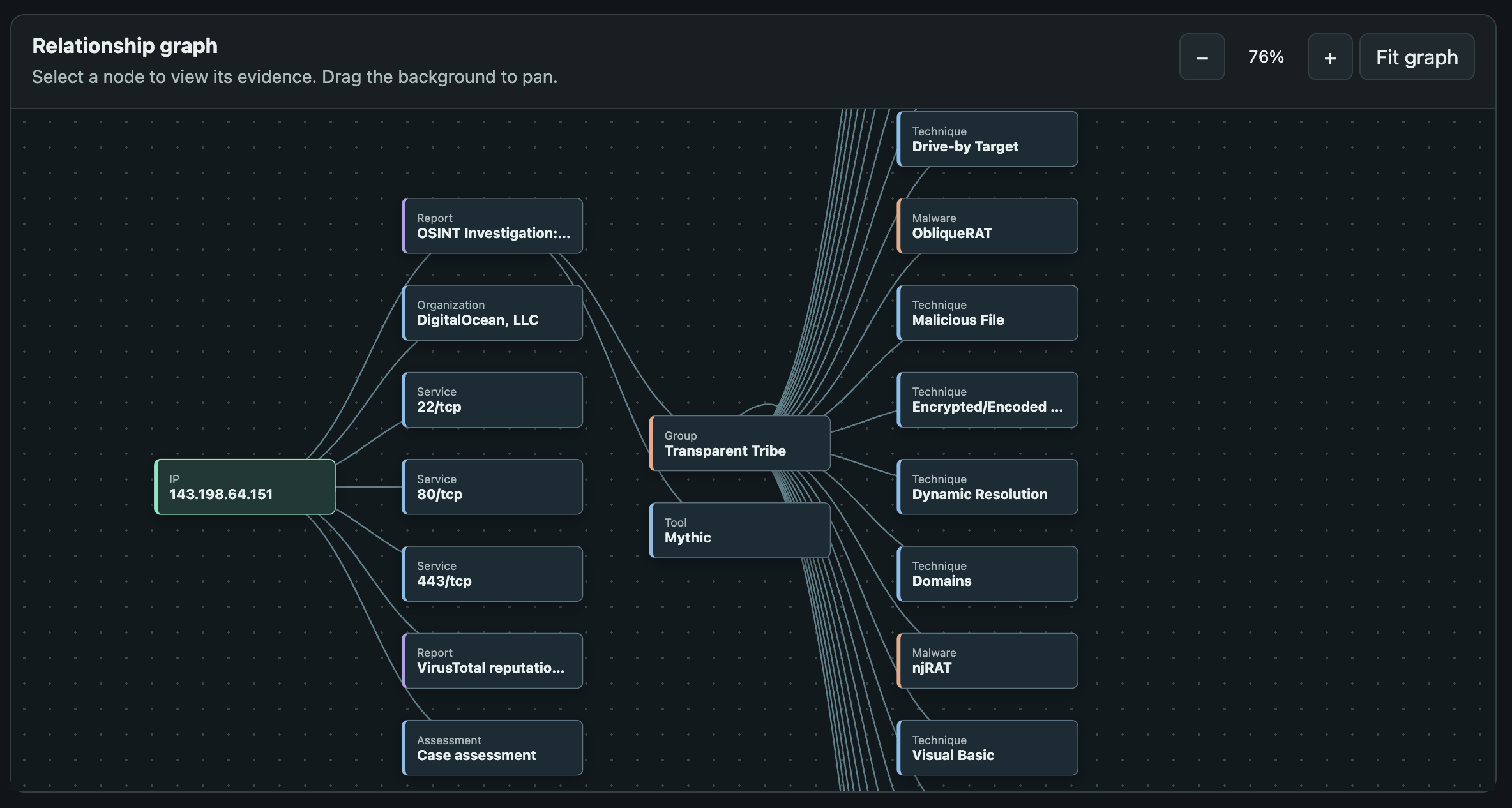
A relationship graph, STIX 2.1 export, and local SHA-256 snapshots of verified pages — citations lead back to the original source.
How it works
From a seed to an auditable case
Seed
Enter IOCs, CVEs, ASNs, CIDRs, wallets, hashes, or actor names. Defanged input (hxxp, [.]) is normalized and the original is kept.
Collect under policy
The case's TLP decides which source classes run and whether the seed may leave the host. Every outbound query is logged.
Grade & correlate
Evidence is clustered into independent origins, graded with Admiralty reliability and credibility, decayed over time, and filtered for shared infrastructure.
Score & assess
Code computes the 0–5 confidence and its reasons. When the TLP allows, a model writes the narrative and competing hypotheses — never the score.
Review & export
Confirm or reject evidence, open the local snapshot of a verified page, and export the case as JSON or STIX 2.1.
Quickstart
Running in two minutes
You need Docker with Docker Compose. Everything else is optional.
$ git clone https://github.com/V1n1v131r4/OpenInvestigation.git
$ cd OpenInvestigation
$ docker compose up --build -d
# then open http://127.0.0.1:8080
Add provider keys (OpenAI or Anthropic for the assessment; VirusTotal, Shodan, GreyNoise, Censys and more for extra sources) to a local .env. Set OSINT_WEB=0 to run with no external collection at all.
Investigate threats on your terms.
Open source, self-hosted, and transparent about every request it makes and every grade it assigns.